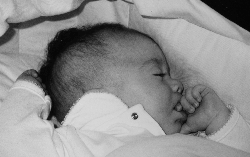
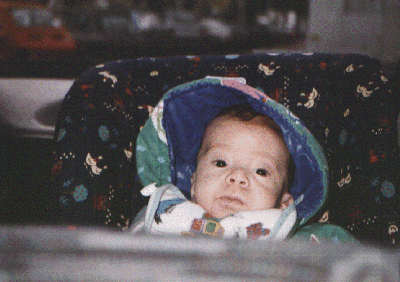
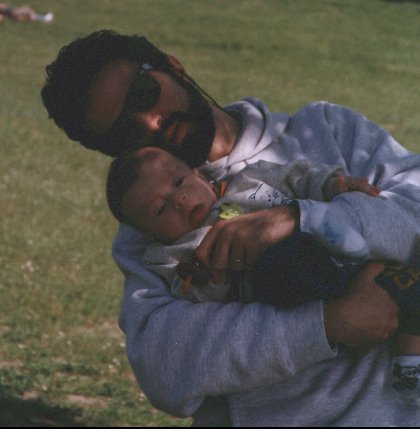
Filippo (Phil) Colasanti was born in Rome, ITALY, on 7th September 1996 after 39 weeks of pregnancy. His weight at birth was 3,750 Kg.
His mother suffered from polyhydramnios probably caused by PKS. She also had an amniocentesis but the syndrome didn't show up.
He suffered from breathing problems (distress) and he was in the Neonatal Intensive Care nursery for 4 weeks. He had low muscle tone at birth, sparse scalp hair, a high forehead, a wide space between the eyes, a broad nasal bridge and hypopigmentation (streaks of skin in which there is no colour).
I will never forget many of the sensations I had during the first days of Phil's life. The first time I saw him with tubes and wires, the long time he spent in the hospital (4 weeks) with the daily visits taking hundreds of kilometres. The vague explanation that doctors gave us.
We didn't receive very good support from the Italian Health Care system at the beginning and we spent a lot of time in finding the right specialists. PKS was quite mysterious in Italy in 1996 and it still is pretty unknown.At the beginning we wasted a lot of time and money with doctors asserting the strangest hypothesis like the percentage of iron in his blood. One doctor told us that the child was almost perfect, another one told us that he was in terrible conditions. We were really confused and sad.
Phil has been diagnosed with PKS at the age of 20 months. The diagnosis was that 26% of his cells are injured with Tetrasomy 12p 46,XY[37]/47,XY,+i(12p)[13] also known as Pallister-Killian Syndrome.
The syndrome was relatively "new", very poorly spread and studied and it has so many characteristics that could be attributable. Everything about it makes it a complex syndrome to manage.
The approach that we followed was to give low relevance to the genetic aberration itself but instead consider each single symptom individually, concentrating on the problems and trying to solve them one at a time. At the beginning I was disorientated but now I feel it was quite a good way to approach an unknown syndrome. And it is working.